
India's pharmaceutical exports to Iran have been hit owing to depleting rupee reserves in the West Asian country because of India stopping the import of crude oil from it in 2019 following US sanctions. Pharmaceutical exports dropped 71.25 per cent in April-August this year over the same period last year. The data from the Pharmaceutical Exports Promotion Council (Pharmexcil) showed exports to Iran had declined 31.29 per cent in 2022-23 as against the previous financial year.

"The report is out of context and factually incorrect. Tata's comments on wealth are in the larger context of the growing disparity in the society. The comments seem to have been deliberately sensationalised," a statement from Tata Sons said.

India, the world's third-largest energy consumer, will see its energy needs doubling by the end of this decade as it witnesses an unprecedented explosion of economic growth, the nation's richest man Mukesh Ambani said on Saturday. Speaking at the convocation of Pandit Deendayal Energy University (PDEU), Ambani, who heads the nation's most valuable company Reliance Industries Ltd, said the Indian economy will become a $40 trillion economy by 2047 from the current $3.5 trillion. "And to fuel this growth, the country will need enormous amounts of energy - clean, green energy that won't choke mother nature for the sake of human progress," he said.
India's exporters may be hard hit by the appreciation of rupee against dollar. But the rising value of rupee has cheered the diamond industry in the country.
It was not all that bright on the industry front in Tamil Nadu, one of the major industrial hubs in the country, towards 2008-end in the wake of the global meltdown, though the state government's pro-active actions fetched it Rs 37,000-crore (Rs 370 billion) investment commitments in the year.
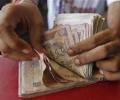
Forex dealers said besides increased selling of the American currency by exporters and banks, the dollar's weakness against other currencies overseas also supported the rupee, but a lower opening in the domestic equity market limited the rise.

The collapse of Silvergate Bank, Silicon Valley Bank (SVB) and Signature Bank in the US might create temporary liquidity issues but will not have any significant impact on the Indian crypto market in the long run, officials from several exchanges told Business Standard. All three banks are considered crypto-friendly. SVB offered services such as cryptocurrency custody and lending.

From the Sensex pack, Infosys jumped the most by 3.67 per cent. Asian Paints, HCL Technologies, Reliance Industries, ICICI Bank, Wipro, NTPC, Tech Mahindra, Bajaj Finserv and Larsen & Toubro were among the other major gainers. State Bank of India, Bajaj Finance, Titan, Tata Steel, Tata Motors and UltraTech Cement were among the laggards.

India will be an important country in terms of manufacturing in future, Young Liu, chairman and CEO of Hon Hai Technology Group (Foxconn) has said, his latest comment adding to a growing chorus of global voices acknowledging the country's bold moves to position itself as electronics and hi-tech production powerhouse. In an interaction with reporters in Taipei, the top honcho of the Taiwanese electronics manufacturing giant said the development of the entire ecosystem and industrial chain, and opportunities for development in India are "very, very huge opportunities". "If there is no big change, India will be a very important country in terms of manufacturing in the future," Liu said.

Equity markets rallied after softer-than-expected inflation data in the US and UK rekindled hopes of the end of the rate-hiking cycle by major central banks. The soft inflation reading drove down bond yields and the US dollar, whetting the appetite for risky assets. The 10-year US bond yield fell below 4.5 per cent after topping 5 per cent less than a month ago.
.jpg)
In the global market, the dollar was quoted lower in the early trade with investors looking ahead to the following day's European Central Bank policy decision.

Rupee ends at 61.89 against the dollar, falls for second straight day.

This is the biggest one-day fall in the rupee since August 3, 2016

The industrial production grew by two per cent in September, mainly on account of better performance by power and mining sectors.
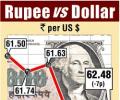
The rupee was also pressured as the euro fell for a second day on Friday, hurt by the European Central Bank's surprise interest rate cut and a downgrade to France's credit rating, while the dollar inched up before a key US jobs report.

Gold prices are struggling and are down 18 per cent from their March highs. But stock prices have fallen even more. As a result, the precious metal has begun to outperform equities - both in the domestic market and international markets. Gold prices are up 2.6 per cent in the domestic market in the current calendar year (CY22) so far, according to the World Gold Council (WGC), compared to a 1.7 per cent decline in the Sensex year-to-date (YTD).

Equity markets would be mainly driven by global trends and foreign fund trading activity in the holiday-shortened week, analysts said. The BSE and the National Stock Exchange have listed March 7 (Tuesday) as a holiday on account of Holi. However, stock brokers' association ANMI has urged the government, exchanges and Sebi to shift the holiday to March 8 from March 7.
Sanctions-hit Iran government has earned millions of United States dollars by hosting the 13th Non-Aligned Movement Summit here which was attended by representatives from over 50 countries. According to Iran's own calculations, it would have earned at least $50 million.

Indian rupee, which earlier this week touched an all-time low, is likely to remain under pressure and may test new levels as a fallout of the US Federal Reserve indicating more interest rate hikes, experts said. The aggressive rate hikes will dampen demand and increase the possibility of a recession in the US. This could accelerate the pace of capital outflows, weaken the rupee and raise the threat of imported inflation.

The rupee on Friday rebounded from the near-80 levels to close higher by 17 paise at 79.82 against the US currency following a recovery in the domestic stocks and weakness in the greenback in overseas markets. The US dollar retreated from the two-decade high levels against a basket of six currencies which supported the rupee sentiment. At the interbank foreign exchange market, the local currency opened at 79.95 and witnessed an intra-day high of 79.82 and a low of 79.96 against the US dollar in the day trade. ,

Beijing did not announce expected policy support over the weekend

The rupee fell to an all-time low of 61.21 on Monday, sparking speculation about potential measures from the Reserve Bank of India, including providing a special window for oil companies to buy dollars.
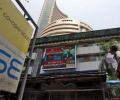
Benchmark indices Sensex and Nifty declined in early trade on Wednesday due to selling in financials, oil and IT stocks amid weak global trends.
The publishing industry in the western countries, which once thrived because of the cost advantage, was suffering from high cost of production, including wages. With advent of digital printing, the cost of printing books had also become costlier, due to high cost of paper and machinery.

Domestic stock markets would be driven by inflation numbers, global trends, and the last batch of Q4 earnings this week, analysts said. Markets will also react to industrial production data and consumer inflation numbers that were released after market hours on Friday. "Participants will react to macroeconomic data viz. IIP and CPI first, which were released post-market hours on Friday.

Forex dealers said besides continued demand for the American currency from importers, increased capital outflows by foreign funds kept pressure on the rupee.
As many as 267 of 453 companies from the BSE500 index are trading above their consensus price targets, according to the data compiled by Bloomberg. Not all companies in the BSE500 index are tracked by analysts.

Company is looking to raise the funds through dollar-denominated loans.

Democratic presidential nominee Hillary Clinton on Monday took a dig at the tax return expose of her Republican rival Donald Trump by questioning his business credentials.

Have the markets already played out their dynamics before the economy has even properly taken off? Are we now destined for a period of mediocre returns despite a strong economy? asks Akash Prakash.
Among Sensex stocks, Tata Motors rose the most by 2.79 per cent. NTPC, Reliance Industries, Infosys, TCS, HDFC twins, Tata Motors, ITC, Power Grid and Bajaj Finserv were among the major gainers. Tata Steel fell the most by 1.22 per cent. L&T, Sun Pharmaceuticals, IndusInd Bank and Ultratech Cement were among the losers.

India's import of discounted crude oil from the Russian Federation hit an all-time high in May, with state-run refiner IOC becoming the biggest importer of Russian oil, relegating Reliance Industries to the second place, trade and shipping data show. Indian imports of Russian oil, accounting for over 46 per cent of its total crude oil imports in May, have grown after strong backing by New Delhi, with state-run refiners powering imports of discounted crude. Discounts on Russian oil average around $10 a barrel, said an official from a state-run refiner. IOC's May purchases rose by 64 per cent on the month, and accounted for half of its total crude imports last month, ship tracking data show.

The domestic benchmark indices - the S&P BSE Sensex and the National Stock Exchange Nifty50 - had lost close to 1.5 per cent in three days recently before gaining slightly. Notwithstanding weakness and volatility, the Nifty50 has managed to hold on to the 18,000 mark, while the Sensex has managed to stay above the 61,000 level. The performance of the stocks that comprise these front-line indices remains polarised.

Growing protectionism in their main markets - the US and the UK - has forced them to hire local workers, upending the cost arbitrage model they had built their business on.
While the Indian advertising industry sees IPL as a potential vehicle in a retail booming Indian economy, they are unsure if it can match early expectations.

The Indian startup ecosystem has lauded the inclusion of startups in the New Delhi Leaders' Declaration for the first time ever in the history of G20. Industry stakeholders say that the move will lead to easier access to capital, reduce regulatory hurdles, and may revive funding activity. The Declaration, through the Startup20 initiative, recognised startups as "natural engines of growth" and key to socio-economic transformation by driving innovation and creating employment.

The challenges before the IT industry are many and its response over the coming months will shape the future of what has been one of the most vibrant value-creating and livelihood-enabling sectors.

'Just the amount of work which is there just to become more and more successful in banking. For this to happen you need to have leaders who understand technology.'
By posting revenues of Rs 2,135 crore, the training sector also recorded a significant growth, as demand for training within corporations in India and overseas grew.
 © 2026 Rediff.com - Advertise with us - Disclaimer - Privacy Policy - Sitemap - Feedback - About us - Terms of use - Grievances